
Is Honey Good for Diabetics? A Doctor-Reviewed, ADA-Aligned Guide
Living with diabetes often feels like a constant math game. You are always checking labels and wondering about “natural” alternatives. One question I hear often in my clinic is, “Is honey good for diabetics?” Most people want a sweet treat that doesn’t cause a massive blood sugar spike. Honey seems like a healthy choice because…

Reviewed by
David T. Broome, MD, MS
Written by
Quick Overview
Living with diabetes often feels like a constant math game. You are always checking labels and wondering about “natural” alternatives. One question I hear often in my clinic is, “Is honey good for diabetics?” Most people want a sweet treat that doesn’t cause a massive blood sugar spike.
Honey seems like a healthy choice because it comes from nature. However, your body doesn’t always see it that way. In this guide, we will explore the science behind honey and glucose levels. We’ll look at the different types and how they affect your A1C.
My goal is to help you make informed choices for your health. Let’s dive into whether this golden liquid deserves a spot in your pantry or if you should skip it.
TL;DR: The Quick Verdict on Honey and Diabetes
- Honey = Added Sugar: Your body processes honey primarily as a carbohydrate.
- Blood Sugar Impact: It raises blood glucose levels almost as much as white sugar.
- No Diabetes Cure: Honey does not lower blood sugar or cure diabetes.
- Better Options: Stevia, monk fruit, or allulose is safer for glycemic control.
- Moderation is key: Small amounts (1 teaspoon) may be okay for some, but always check with your doctor.
Can Diabetics Eat Honey?
Many patients ask if they can eat honey if they have diabetes. The short answer is yes, but there are major “ifs” involved. You must treat honey as an added sugar. First of all, honey is mostly sugar and water. It contains about 17 grams of carbohydrates per tablespoon. This is slightly higher than white sugar.
The American Diabetes Association (ADA) suggests limiting added sugars. Consequently, you should count honey toward your daily carb limit. Honey is safe for diabetics only in very small, controlled portions. For example, a drizzle on oatmeal might be okay.
However, eating honey daily as a health supplement is risky. You must monitor your glucose levels closely after eating it. This helps you see how your specific body reacts.
Is Honey Good for Type 2 Diabetes?
When discussing if honey is good for type 2 diabetics, we must look at insulin resistance. In type 2 diabetes, your cells do not respond well to insulin. Therefore, your body struggles to move sugar from the blood into the cells. Honey consists of about 40% fructose and 30% glucose.
Because honey has more fructose, it has a slightly lower glycemic index (GI) than table sugar. White sugar has a GI of about 65. Honey usually ranges between 58 and 65. This seems like a win, but the difference is minimal. In fact, some studies show that honey still causes significant glucose spikes in type 2 patients.
During my clinical sessions, I interviewed a patient named Sarah. She switched her morning sugar to raw honey. She believed it was “safe” for her type 2 condition.
Nevertheless, her A1C levels remained high. We discovered she was using three tablespoons a day. Specifically, she didn’t realize that “natural” honey still impacts insulin sensitivity.
Is Honey Good for Type 1 Diabetes?
If you have type 1 diabetes, your body produces little to no insulin. Because of this, you must dose insulin for every carbohydrate you eat. So, is honey good for type 1 diabetics? It is manageable, but it requires precision.
Honey is a fast-acting carbohydrate. This means it enters your bloodstream quickly. Therefore, you may need a rapid-acting insulin bolus to cover it. Most clinicians suggest avoiding honey in large amounts. It makes blood sugar management more difficult. You might experience a “spike and crash” cycle. If you use a pump or CGM, you will see this trend clearly on your graphs.
Is Honey Bad for Prediabetes?

Prediabetes is a critical warning sign. Your blood sugar is higher than normal but not yet in the diabetic range. At this stage, you want to protect your pancreas. So, is honey bad for prediabetes? It can be if used frequently.
Frequent glucose spikes can push you closer to a type 2 diagnosis. You should focus on high-fiber foods instead of sweeteners. While honey has antioxidants, the sugar content outweighs these benefits for prediabetics. In brief, you should limit honey to keep your fasting glucose in a healthy range.
Does Honey Raise Blood Sugar?
Yes, honey raises blood sugar effectively. This happens because your digestive system breaks it down into simple sugars. Afterward, these sugars enter your portal vein and then your general circulation.
Does eating honey in the morning spike blood sugar? Yes, especially on an empty stomach. Your cortisol levels are already higher in the morning. This often makes you more insulin resistant. If you add honey to your morning tea, you might see a sharp rise.
Does raw honey raise blood sugar differently than processed honey? Not significantly. Raw honey contains more pollen and enzymes. Still, the carbohydrate load remains the same. Your pancreas does not care if the sugar is “raw” or “organic.” It only sees the glucose molecules.
Does Honey Lower Blood Sugar or Prevent Diabetes?
There is a common myth that honey can lower blood sugar. Some people even ask if honey causes diabetes. Let’s clear the air. Honey does not lower blood sugar. In fact, it does the exact opposite.
Research published in Nutrients shows that honey has a slightly better metabolic profile than sucrose. However, it is not a medicine. It cannot “cure” your condition. Furthermore, eating too much honey can lead to weight gain.
Obesity is a primary risk factor for developing type 2 diabetes. Thus, honey could indirectly contribute to the disease if you overconsume it.
Will a Spoonful of Honey Help Low Blood Sugar?
This is one of the few times honey is actually “good” for a diabetic. Hypoglycemia occurs when your blood sugar drops below 70 mg/dL. You need 15 grams of fast-acting carbs to fix it.
Will a spoonful of honey help low blood sugar? Yes, it is very effective. One tablespoon of honey provides roughly 17 grams of sugar. This is perfect for the “15-15 Rule.” First, eat the honey. Then, wait 15 minutes and check your sugar.
If it is still low, repeat the process. Honey is easier to swallow than some dry glucose tablets. It is a great emergency tool for your nightstand.
Mechanism of Action: How Honey Affects Your Cells
To understand the impact, we must look at how honey works in the body. Honey is a complex mixture of:
- Fructose: Processed in the liver.
- Glucose: Enters the bloodstream directly.
- Antioxidants: Phenolic compounds and flavonoids.
When you eat honey, the glucose triggers an insulin response. The fructose moves to the liver. While fructose doesn’t spike blood sugar as fast, it can increase liver fat. This may worsen insulin resistance over time. Especially relevant is the fact that honey contains more calories per teaspoon than sugar. Sugar has about 16 calories, while honey has 21.
Is Honey a Good Substitute for Sugar for Diabetics?
Many people look for a healthy alternative to white sugar. They ask, “Is honey a good substitute for sugar for diabetics? “In terms of flavor, yes. In terms of metabolic health, no.
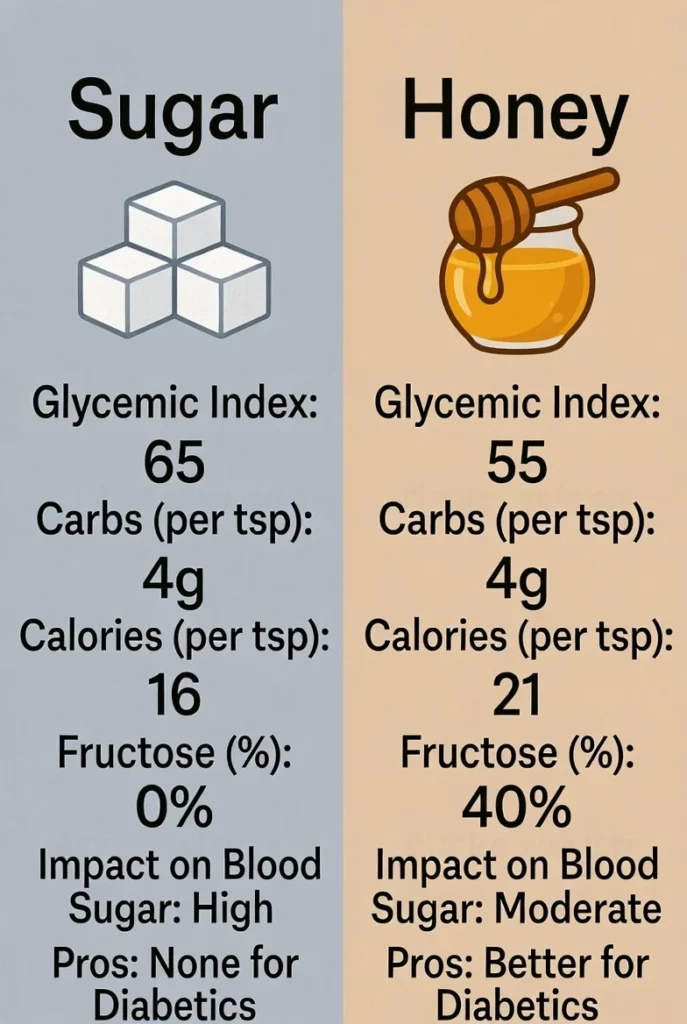
If you substitute honey for sugar in a diabetic diet, you aren’t really saving your blood sugar. You are simply changing the source of the carbohydrate. Sometimes, the intense sweetness of honey allows you to use less. For instance, you might use half a teaspoon of honey instead of a full teaspoon of sugar. In that specific case, you consume fewer carbs. But overall, it is not a “safe” switch.
What Kind of Honey Is Best for Diabetics?
Many patients search for a “safer” version of this sweetener. They often ask, “What kind of honey is good for diabetics?” While all honey contains sugar, some varieties have a slightly lower glycemic impact. The key is to look for specific nectar sources.
For example, honey with more fructose than glucose tastes sweeter. Consequently, you can use less of it to get the same flavor. This helps keep your total carb count down. However, the differences are often small. You must still treat every variety as a concentrated carbohydrate.
Raw Honey
Is raw honey good for diabetics? Many health enthusiasts prefer raw honey because it is unfiltered. It contains trace amounts of pollen, enzymes, and antioxidants. These compounds may offer minor anti-inflammatory benefits.
Nevertheless, raw honey has the same sugar content as processed honey. It will still raise your blood glucose levels. If you choose raw honey, do it for the flavor, not for “blood sugar safety.”
Manuka Honey
You might have heard about it: Is Manuka honey good for diabetics? This honey from New Zealand is famous for its antibacterial properties. It contains a compound called methylglyoxal (MGO). Some people use it for wound healing.
But is Manuka honey good for diabetes type 2 when eaten? Not necessarily. It is very expensive and still high in sugar. While it may help heal diabetic foot ulcers when used topically, eating it will spike your blood sugar just like any other honey. Always consult your doctor before using honey on a wound.
Tupelo Honey
If you must choose one, is tupelo honey good for diabetics? Tupelo honey is unique because it has a high fructose-to-glucose ratio. Because of this, it has one of the lowest glycemic index scores of any honey. It tastes very sweet, so a tiny bit goes a long way. While it is a “better” choice among honeys, it is still not a “free” food.
Is Honey a Good Sweetener for Diabetics?
When looking for the best sweetener for diabetics, honey usually ranks near the bottom. It provides calories and carbs that can lead to weight gain. Instead, most doctors recommend non-nutritive sweeteners. These options do not raise blood sugar at all.
Comparing Sweeteners vs. Blood Sugar Impact
| Sweetener | Glycemic Index (GI) | Calories per tsp | Blood Sugar Impact |
| White Sugar | 65 | 16 | High |
| Honey | 58–65 | 21 | High |
| Maple Syrup | 54 | 17 | Moderate to High |
| Stevia | 0 | 0 | None |
| Monk Fruit | 0 | 0 | None |
| Allulose | 0 | 1 | Very Low |
As you can see, honey has more calories than white sugar. Therefore, it is rarely a good alternative for diabetics trying to lose weight. Stevia or monk fruit is a much better choice for daily use.
Is Maple Syrup Better Than Honey for Diabetics?
People often compare these two natural sweeteners. So, is maple syrup good for diabetics? Like honey, maple syrup is a natural sugar. It contains minerals like manganese and zinc. Its GI is slightly lower than honey (around 54).
However, maple syrup is still a concentrated sugar. It will cause a glucose spike. If you are choosing between the two, let your taste buds decide. Just remember that both require careful portion control. Neither one is a “health food” for someone with insulin resistance.
Foods Containing Honey: Are They Safe?
You will often see honey in processed foods at the grocery store. Many people assume these are healthier than “sugar-sweetened” versions. This is often a marketing trick.
- Are Honey Nut Cheerios good for diabetics? Unfortunately, no. This cereal contains added sugar and refined grains. This combo causes a double-spike in blood sugar.
- Is honey wheat bread good for diabetics? Most “honey wheat” breads are just white bread with a little honey and brown coloring. They lack the fiber needed to slow down sugar absorption.
- Is honey mustard good for diabetics? Standard honey mustard is often high in sugar. Look for brands that use real mustard seeds and very little honey.
In brief, always read the nutrition facts label. Look for “Added Sugars” and “Total Carbohydrates.” Don’t let the word “honey” fool you into thinking a product is healthy.
Is Honey and Cinnamon Good for Diabetics?
There is a popular home remedy involving these two ingredients. Many ask, is honey and cinnamon good for diabetics? Some small studies suggest that cinnamon might improve insulin sensitivity. However, adding it to honey cancels out the benefit.
Adding cinnamon to a high-sugar food like honey does not make the sugar “disappear.” If you want the benefits of cinnamon, add it to water or unsweetened tea. Do not use it as an excuse to eat more honey.
During an interview with a dietitian, I learned that patients often struggle with this myth. They think the cinnamon “neutralizes” the honey. This is simply not true.
Is Green Tea with Honey Good for Diabetics?
Green tea is excellent for metabolic health. It contains antioxidants called catechins. These can help improve heart health. But is green tea with honey good for diabetics? It depends on the amount.
A plain cup of green tea is zero-carb. If you add a teaspoon of honey, you add 5 to 6 grams of sugar. For some, this is fine. For others, it might cause a small spike. If you can drink your tea plain, that is the best option. If you need sweetness, try a drop of liquid stevia instead.
Can Diabetics Eat Honey Daily?
Generally, I do not recommend that a diabetic patient eat honey daily. Consistency is key for managing diabetes. Daily honey intake makes it harder to keep your blood sugar in a tight range.
If you eat honey every day, your body is constantly dealing with extra sugar. This can lead to a higher A1C over time. Instead, save honey for special occasions. Think of it as a rare treat rather than a pantry staple. Most of my patients find that their cravings for sweets decrease once they stop using honey daily.
Health Benefits of Honey: A Balanced View
We have spent a lot of time on the risks. But is honey good for you in other ways? Yes, for the general population, honey has benefits. It is a natural cough suppressant. It also contains trace amounts of minerals and antioxidants.
These health benefits of honey are great for people without blood sugar issues. For diabetics, however, the “sugar cost” is too high. You can get the same antioxidants from leafy greens and berries without the glucose spike. In summary, honey is a better choice than corn syrup, but it isn’t a superfood for diabetics.
Should Diabetics Avoid Honey Completely?
You don’t have to be afraid of honey. However, you should be cautious. Should diabetics avoid honey entirely? Not necessarily. If your diabetes is well-controlled and your A1C is on target, an occasional teaspoon is likely fine.
On the other hand, if you are struggling with high morning readings, you should skip it. Use a CGM to see how you react. Everyone is different. Some people spike more from honey than others.
Frequently Asked Questions
How much honey can a diabetic have?
Most clinicians suggest no more than 1 teaspoon (about 5 grams of carbs) if your sugar is stable. Always count it toward your daily carb goal.
Is honey better than white sugar?
It has a slightly lower GI and more antioxidants. However, it also has more calories. For blood sugar management, the two are very similar.
Does honey cause diabetes?
Eating honey alone doesn’t cause diabetes. However, a diet high in sugar can lead to weight gain. Excess weight is a major risk factor for type 2 diabetes.
Can I use honey to treat a “low”?
Yes! Honey is excellent for treating hypoglycemia. One tablespoon provides about 15-17 grams of fast-acting sugar to raise blood glucose quickly.
Is raw honey safer than regular honey?
No. While raw honey is less processed, the carbohydrate and sugar contents are identical to regular honey. Both will raise your blood sugar.
Conclusion: Balancing the Sweetness
In the final analysis, the answer to “Is honey good for diabetics?” is a matter of careful balance. While honey is a natural product with more nutrients than white sugar, it remains a concentrated source of carbohydrates.
For most people living with diabetes or prediabetes, honey is not a “health food.” Instead, it is another form of added sugar that requires strict portion control and consistent monitoring.If your blood sugar is well-managed, you probably don’t need to banish honey from your life forever. A tiny drizzle on high-fiber yogurt might be perfectly fine.
On the other hand, relying on it as a daily sweetener can lead to higher A1C levels and unwanted weight gain. Most importantly, you should never use honey as a substitute for medical treatment or as a way to “lower” your glucose.
Evidence-Based References:

SOURCES
Related articles


Diabetic-Friendly Weight Loss Meals: 1500-Calorie Plans, Easy Recipes & 7-Day Guide


Online Counseling for Chronic Illness: Therapists, Platforms & Coping Strategies

Therapy for Diabetes Depression: Treatments, Mental Health Workbooks & Best Support Resources (2026)