
Is Diabetes Genetic or Hereditary? What Science Says About Family Risk
Have you ever looked at your family tree and wondered about your health? Many patients sit in my office with this exact worry. My colleague recently interviewed a patient who was terrified. His father and grandfather both struggled with blood sugar issues. He asked her, “Is diabetes genetic?” and felt doomed by his DNA. However,…

Reviewed by
David T. Broome, MD, MS
Written by

Quick Overview
Have you ever looked at your family tree and wondered about your health? Many patients sit in my office with this exact worry. My colleague recently interviewed a patient who was terrified. His father and grandfather both struggled with blood sugar issues. He asked her, “Is diabetes genetic?” and felt doomed by his DNA.
However, the truth is much more empowering. Diabetes is a complex puzzle. While your genes definitely increase your risk, they do not guarantee you will get sick. Your lifestyle and environment matter just as much. If you want to know if diabetes is hereditary, you are in the right place. Let’s break down exactly what science says about your family risk.
TL;DR Summary Box
Are you short on time? Here is the quick medical answer to whether diabetes is genetic or hereditary.
- The Short Answer: Yes, family history significantly increases your overall risk.
- Type 1 Risk: You inherit specific autoimmune flaws. Then, an environmental trigger actually starts the disease.
- Type 2 Risk: This type has a massive genetic link. However, poor diet and physical inactivity ultimately pull the trigger.
- Inheritance Rule: You inherit the metabolic susceptibility, not the guaranteed illness.
- Your Power: Genetics loads the gun, but lifestyle pulls the trigger. Therefore, daily exercise and whole foods can often prevent the disease entirely.
Is diabetes a genetic disorder?
First of all, many people ask, is diabetes a genetic disorder? The medical answer is yes, but with a catch. It is not like eye color where one single gene dictates everything. Instead, researchers link multiple genes to diabetes. These genes control how your body processes sugar. Furthermore, they interact heavily with your environment. Therefore, having the genes only means you are susceptible.
If you are wondering, is diabetes a genetic disease? Think of it as a team effort. Your DNA sets the stage. However, your daily habits usually decide the final outcome.
How Genetics Affect Diabetes Risk
To understand how diabetes is genetic, we must look at your body’s mechanics. Genetics affect diabetes by altering how you make and use insulin. Insulin is the key that unlocks your cells.
Some people inherit genes that cause insulin regulation issues. As a result, their pancreas might not produce enough. Other genes affect glucose metabolism directly. Consequently, sugar stays trapped in the blood.
Additionally, immune system genes play a massive role. This is especially true for autoimmune forms of the disease. If you want to know why diabetes is genetic, the biological answer lies in these tiny cellular instructions.
Is type 1 diabetes genetic?
Next, let us dive into specific types. A very common question is, “Is type 1 diabetes genetic?” Yes, it has a strong genetic link. Type 1 operates as an autoimmune condition. This means your immune system mistakenly attacks your own pancreas.
Specifically, it destroys the exact cells that make insulin. Therefore, your body cannot regulate sugar on its own.
People often wonder, is diabetes type 1 genetic from birth? The genetic risk exists at birth. However, the disease itself usually needs a trigger to activate. This is a crucial distinction. For example, an environmental trigger like a virus might spark the immune response. Scientists are still studying exactly what these specific triggers are. Consequently, even with the genes, you might never develop the illness.
So, is diabetes type 1 genetic? Yes, but it remains very complex. Interestingly, most people who develop type 1 do not have a family history. This makes the condition highly unpredictable. If you ask, is type one diabetes genetic? Doctors look at specific markers. We call these HLA genes.
Having certain HLA genes drastically increases your overall risk. Furthermore, specific populations show higher rates. In conclusion, is type 1 diabetes genetically inherited? You inherit the predisposition. However, the disease itself is not a guaranteed inheritance. Your immune system must ultimately flip the switch.
Is type 2 diabetes genetic?
On the other hand, what about the most common form? Is type 2 diabetes genetic? This is where things get really interesting. Type 2 actually shows a stronger genetic link than type 1. If you have a parent with type 2, your risk skyrockets. People frequently ask me, is diabetes type 2 genetic? Yes, family history acts as a massive predictive factor for this condition.

However, the medical community connects type 2 deeply to your daily habits. It represents the perfect example of nature versus nurture. Your genes create insulin resistance. Then, a poor diet worsens it. Therefore, asking if diabetes 2 is genetic is only half the question. You also have to look at shared family habits. Families share DNA, but they also share recipes and activity levels.
If your family eats a highly processed diet, that environment triggers the genetic risk. Consequently, type 2 diabetes genetic factors often amplify due to the lifestyle you grow up in. Because of this, type 2 is incredibly preventable. Even with a strong family history, you can fight back. Healthy eating and daily exercise can keep those genetic switches turned off indefinitely.
In summary, the genes for type 2 make your body struggle with insulin. Obesity then makes that cellular struggle much harder. Losing weight can often overcome the genetic disadvantage completely.
Is diabetes genetic or lifestyle?
This brings us to a massive medical debate. Is diabetes genetic or lifestyle? In the medical community, we have a famous saying. Genetics loads the gun, but lifestyle pulls the trigger. So, is type 2 diabetes genetic or a lifestyle choice? It is absolutely both. You might inherit the biological blueprint for insulin resistance. However, eating highly refined carbs activates that specific blueprint.
Similarly, is type 1 diabetes genetic or lifestyle-related? Type 1 relies mostly on genetics and environmental triggers. Lifestyle choices like diet do not cause type 1. However, good lifestyle habits help manage it. For type 2, lifestyle factors act as your biggest weapons. Daily habits like poor diet, inactivity, and obesity drive the disease. Furthermore, poor sleep and high stress elevate your blood sugar.
Therefore, you are never powerless. Even if you have bad genetics, a good lifestyle protects you. Regular exercise literally forces sugar into your muscles. This action bypasses insulin resistance entirely.
Is diabetes genetic or environmental?
Another common question naturally arises here. Is diabetes genetic or environmental? As we discussed, the environment plays a massive role. This truth applies to all types of disease. For type 1, environmental triggers might include early viral infections.
Some researchers also suspect early childhood diet plays a role. However, these specific theories require much more scientific study.
For type 2, the environment proves undeniable. Is diabetes genetic or diet? Diet acts as a huge environmental factor. Living in a ‘food desert’ without fresh vegetables increases your risk. Furthermore, a sedentary environment actively harms your metabolism. If you sit at a desk all day, your muscles ignore insulin. Therefore, changing your physical environment becomes crucial for true prevention.
Is diabetes hereditary from parents or grandparents?
Many patients ask me specifically about their direct family tree. For instance, is diabetes genetic from a mother or father? The short answer is yes. If one parent has type 2 diabetes, your risk increases significantly. If both parents have the condition, your risk jumps even higher. Furthermore, researchers know that a mother’s health during pregnancy matters. If she had high blood sugar, the baby would face a higher lifetime risk.
Consequently, people also wonder, is diabetes hereditary from grandparents? Absolutely. Genetic traits skip generations all the time. If your grandfather had it, you carry some of those same genetic markers. Therefore, asking if diabetes is genetic from grandparents is a smart question. You should always look at your entire family history. This broad view gives doctors the best picture of your inherited risk.
What Is the Genetic Component of Type 2 Diabetes?
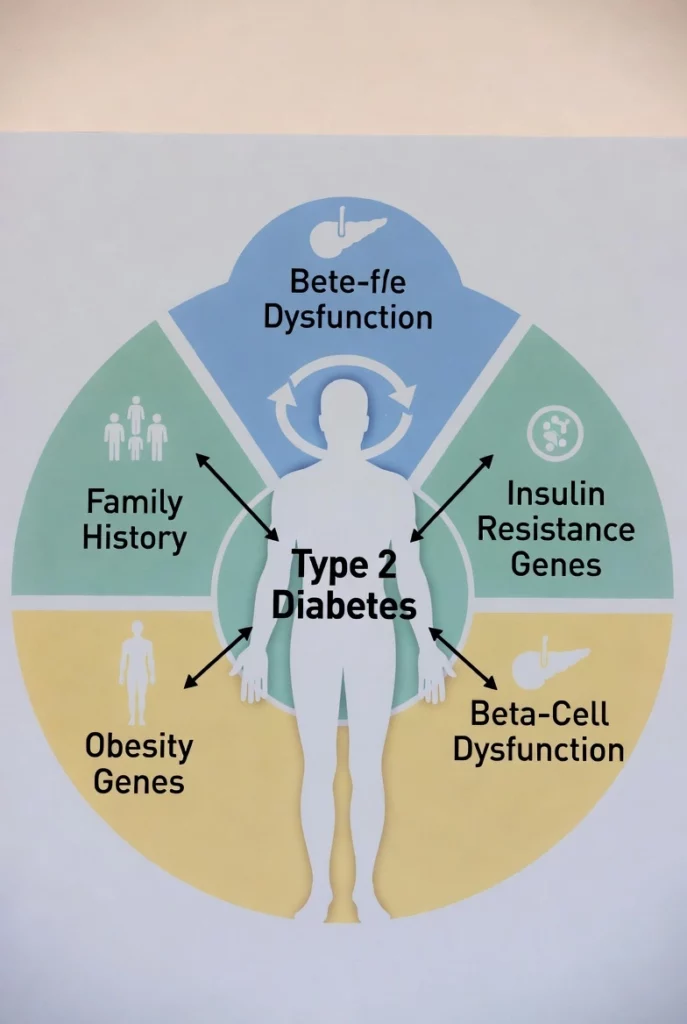
To truly understand the risk, we need to look at the math. So, what is the genetic component of type 2 diabetes exactly? Scientists use twin studies to measure this. If one identical twin gets type 2 diabetes, the other twin has a huge risk.
Specifically, that risk is often over seventy percent. Because they share exact DNA, this proves a massive genetic link.
Therefore, the type 2 diabetes hereditary percentage usually sits between 40% and 70%. That is a very high number. However, it still leaves a large portion up to your daily choices. While genes play a huge role, they still need an active trigger.
Consequently, poor diet and low activity levels activate that genetic percentage. If you stay active, you can often beat those odds.
Will You Get Diabetes If It Runs in the Family?
This is perhaps the most frightening question for my patients. Will I get diabetes if it runs in the family? The answer is a resounding no. It is a risk, not a strict guarantee. Many people ask, “Can diabetes be inherited directly?” You inherit the genetic susceptibility, not the actual disease itself. Therefore, you have immense power to change your future health.
If your whole family has it, you simply need to work harder. You must focus intensely on your nutrition. In addition, you must prioritize daily exercise to protect your insulin sensitivity. As a result, you can break the family cycle.
Just because your parents struggled does not mean you will. Prevention is entirely possible with the right mindset and medical support.
How to Avoid Hereditary Diabetes
Knowing your risk for diabetes is only the first step. Next, you must ask how to avoid hereditary diabetes. First of all, you must maintain a healthy body weight. Excess fat creates severe insulin resistance. Secondly, you need a balanced, whole-food diet. Avoid highly processed sugars and simple carbohydrates. Because these foods spike your blood sugar, they exhaust your pancreas quickly.
Furthermore, you must exercise regularly. Muscle tissue burns a massive amount of glucose. When you exercise, your muscles pull sugar directly out of your blood. This protects your body from high sugar levels. Finally, schedule routine blood tests.
Ask your doctor for an A1C test every single year. Catching high blood sugar early prevents the disease from fully developing.
Is gestational diabetes genetic?
Pregnancy brings its own unique health challenges. Many women ask, “Is gestational diabetes genetic?” Yes, genetics play a very strong role here as well. During pregnancy, the placenta produces hormones that cause insulin resistance. For most women, the pancreas just makes more insulin. However, if you have a genetic predisposition, your pancreas fails to keep up.
Consequently, your blood sugar rises during the pregnancy. Furthermore, having gestational diabetes increases your future risk for type 2 diabetes. It acts as a major warning sign for your long-term health. If your mother had gestational diabetes, your risk is much higher. Early intervention keeps both the mother and the baby safe.
Which Type of Diabetes Is Genetic?
Patients often get confused by the different medical diagnoses. They frequently ask, “Which diabetes is genetic?” The simplest answer is that all forms have genetic ties.
However, the specific mechanics differ wildly. So, what type of diabetes is genetic in terms of autoimmunity? That would be type 1. It relies heavily on inherited immune system flaws. Conversely, which type of diabetes is genetic regarding lifestyle? That is type 2. It requires both the genetic blueprint and a poor environment to fully develop.
In conclusion, you cannot separate genetics from any form of this disease. Your DNA always sets the baseline for your metabolic health.
Can diabetes affect animals?
Interestingly, this disease does not only affect humans. Pet owners often ask, “Is diabetes genetic in dogs?” Yes, veterinarians see strong breed-specific risks in dogs. For example, certain terrier breeds face a much higher risk. Similarly, is diabetes genetic in cats? Absolutely. Feline diabetes closely mirrors human type 2 diabetes.
Therefore, keeping your pets active and at a healthy weight prevents the disease. Just like humans, diet and exercise save animal lives too.
Can type 2 diabetes be reversed?
This is the most hopeful part of my job. Many people ask, can type 2 diabetes be reversed? Yes, doctors now call this “diabetes remission.” My colleague recently interviewed a patient about this exact journey. This patient had a severe family history of type 2 diabetes. However, he completely changed his relationship with food and exercise.
Because he lost forty pounds, his body regained its insulin sensitivity. As a result, his blood sugar normalized completely without medication. His story proves that genetics do not have the final say. Therefore, remission is possible for many people. It requires drastic lifestyle changes and massive dedication. However, reversing the disease adds decades of healthy years to your life.
What Are 20 Warning Signs of Diabetes?
If you have a family history, you must watch your body closely. So, what are 20 warning signs of diabetes you should monitor? Here is a quick, detailed checklist to keep handy.
- Frequent urination, especially at night.
- Unquenchable, excessive thirst.
- Extreme hunger, even after eating meals.
- Unexplained and sudden weight loss.
- Profound fatigue and daily exhaustion.
- Blurry or cloudy vision.
- Cuts and bruises that heal very slowly.
- Tingling or numbness in the hands.
- Burning sensations in the feet.
- Frequent urinary tract infections.
- Recurring yeast infections.
- Dark, velvety skin patches on the neck.
- Chronically dry, itchy skin.
- Unusually fruity-smelling breath.
- Sudden mood swings or irritability.
- Unexplained brain fog or confusion.
- Swollen, red, or bleeding gums.
- Frequent, severe headaches.
- Unexplained muscle weakness.
- Erectile dysfunction in men.
Frequently Asked Questions
Is diabetes hereditary or genetic?
It is both. The terms are often used interchangeably in medicine. You inherit genetic mutations from your parents that make your body susceptible to insulin issues.
Is type 1 diabetes genetic or acquired?
Type 1 has a strong genetic component, but you are not born with the active disease. You acquire the disease later when an environmental factor triggers your immune system to attack your pancreas.
Can diabetes be inherited from parents?
You do not inherit the active disease itself. Instead, you inherit the genetic risk factors. If you live a healthy lifestyle, you can often prevent the disease from ever developing.
What percentage of type 2 diabetes is genetic?
Medical studies show the heritability of type 2 diabetes is between 40% and 70%. This means genetics play a huge role, but lifestyle still accounts for a massive portion of your risk.
No, diabetes is not contagious.
No, it is absolutely not contagious. It is a metabolic and autoimmune condition. You cannot catch it like a cold or the flu from someone else.
Conclusion: Taking Control of Your Genetic Destiny
In the final analysis, understanding if diabetes is genetic or hereditary gives you a massive advantage. While you cannot change the DNA your parents gave you, you can control your environment. Genetics merely load the metabolic gun. However, your daily habits, your diet, and your physical activity level pull the trigger.
Because you now know how family history impacts your risk, you can take immediate action. Do not wait for symptoms to appear. Use this knowledge to build a protective lifestyle today. Focus on eating whole foods, moving your body daily, and getting regular blood tests.
Evidence-Based References:
- American Diabetes Association (ADA) – Genetics of Diabetes
- Centers for Disease Control and Prevention (CDC) – Diabetes Risk Factors
- National Institute of Diabetes and Digestive and Kidney Diseases (NIDDK) – Symptoms & Causes of Diabetes
- Mayo Clinic – Type 2 Diabetes Symptoms and Causes
- World Health Organization (WHO) – Diabetes Overview

SOURCES
Related articles


Diabetic-Friendly Weight Loss Meals: 1500-Calorie Plans, Easy Recipes & 7-Day Guide


Online Counseling for Chronic Illness: Therapists, Platforms & Coping Strategies

Therapy for Diabetes Depression: Treatments, Mental Health Workbooks & Best Support Resources (2026)