

Have you ever felt like your body’s energy system is just… off? Maybe you’ve been feeling unusually tired lately, or perhaps you are constantly reaching for a glass of water. If you have been searching for answers, you likely landed on one big question: what is diabetes?
Hearing this word from a doctor can feel overwhelming, almost like you are learning a new language. But don’t worry, I am here to break it all down for you. In this guide, we will explore the what is diabetes definition in a way that actually makes sense for your daily life.
Whether you are looking for a what is diabetes short answer or a deep dive into the different types, I have you covered. First of all, we will look at how your body processes fuel. Then, we will tackle the symptoms and causes. Are you ready to take control of your health journey?
TL;DR Summary Box
- Core Problem: High blood sugar due to insulin production or resistance issues.
- Primary Types: Type 1, Type 2, Gestational, and Prediabetes.
- Key Symptoms: Excessive thirst, frequent urination, unexplained fatigue, and blurred vision.
- Long-term Goal: Early diagnosis and management to prevent heart, nerve, and kidney complications.
What Is Diabetes in Simple Words?
To understand what is diabetes in simple words, think of your body as a high-performance vehicle. For the car to run, it needs fuel (glucose). Glucose comes from the food you eat. However, the fuel cannot get into the engine without a key.
In your body, that key is a hormone called insulin. When you have diabetes, you either lost the key or the lock is jammed. As a result, the sugar stays in your blood instead of fueling your cells. This what is diabetes simple definition helps explain why you might feel tired even if you are eating well. The “fuel” is there, but your body just cannot reach it.
Is Diabetes a Disease?
Many people ask, is diabetes a disease, or is it just a “condition”? Medically speaking, diabetes is a chronic metabolic disease. Unlike a cold or the flu, it does not simply go away with rest.
However, calling it a “disease” should not feel like a life sentence. With modern medicine, it is a highly manageable state of health. Furthermore, many people live long, vibrant lives by adjusting their lifestyle and following medical advice. Understanding this distinction is the first step toward effective management.
What Is Diabetes Mellitus?
You might see the term what is diabetes mellitus on your medical charts. This is the full formal name for the condition we usually just call “diabetes.” The word “mellitus” actually comes from the Latin word for honey.
Centuries ago, doctors noticed that the urine of people with high blood sugar tasted sweet. Therefore, they added “mellitus” to describe the sugar passing through the system. While we don’t use taste tests today, the name stuck. It is important to distinguish this from what is diabetes insipidus.
Although the names are similar, they are completely different conditions. We will compare them later in this guide to clear up any confusion.
What Are the Types of Diabetes?
When exploring what are the types of diabetes, it is clear that “one size does not fit all.” In fact, there are several distinct versions of this condition. Understanding what is diabetes types is crucial because the treatment for one may not work for another. Typically, clinicians refer to the 4 types of diabetes most commonly seen in practice.
What Is Type 1 Diabetes?
First, let’s look at what is diabetes type 1. This is an autoimmune condition. In this case, your immune system mistakenly attacks the insulin-producing cells in your pancreas. Consequently, your body produces little to no insulin.
During a recent interview with one of Dr. Lloyd’s patients, a young man named Sarah described her diagnosis. She felt like her body had betrayed her overnight. Because what is type 1 diabetes is not caused by diet or lifestyle, it often appears suddenly in childhood or young adulthood. People with type one diabetes must take insulin every day to survive.
What Is Type 2 Diabetes?
Next, we address what is diabetes type 2. This is the most common form, affecting about 95% of people with the disease. In what is type 2 diabetes, your body still makes insulin, but it doesn’t use it well. This is called insulin resistance.
Initially, your pancreas makes extra insulin to keep up. However, over time, it cannot keep the pace. What is diabetes type two is often linked to genetics and lifestyle factors. But remember, it is not just about “eating too much sugar.” It is a complex interaction of biology and environment.
What Is Prediabetes?
Before Type 2 fully develops, many people enter a stage called what is pre diabetes. This means your blood sugar is higher than normal, but not yet in the “diabetes range.” Think of it as a yellow traffic light. It is a warning to slow down and make changes. Fortunately, prediabetes is often reversible with exercise and diet.
What Is Gestational Diabetes?
What is gestational diabetes occurs only during pregnancy. Hormones from the placenta can cause insulin resistance. While it usually goes away after birth, it does increase the risk for Type 2 diabetes later in life.
What Is Type 1.5 Diabetes (LADA)?
A lesser-known type is what is diabetes type 1.5, also called Latent Autoimmune Diabetes in Adults (LADA). It is like a hybrid. It shares the autoimmune markers of Type 1 but develops slowly like Type 2. Doctors often misdiagnose it at first, making it a vital topic for patient awareness.
What Is Type 3 Diabetes?
Scientists are currently researching what is diabetes type 3. This term is sometimes used to describe Alzheimer’s disease when it is triggered by insulin resistance in the brain. While not yet an “official” standalone diagnosis in all clinics, it highlights how sugar affects every organ.
What Is Diabetes Insipidus?
Finally, what is diabetes insipidus is a rare condition related to how your kidneys manage fluids. It has nothing to do with blood sugar or insulin. Instead, it involves a hormone called ADH. People with this condition produce large amounts of diluted urine, but their glucose levels are usually normal.
What Is the Difference Between Type 1 and Type 2 Diabetes?
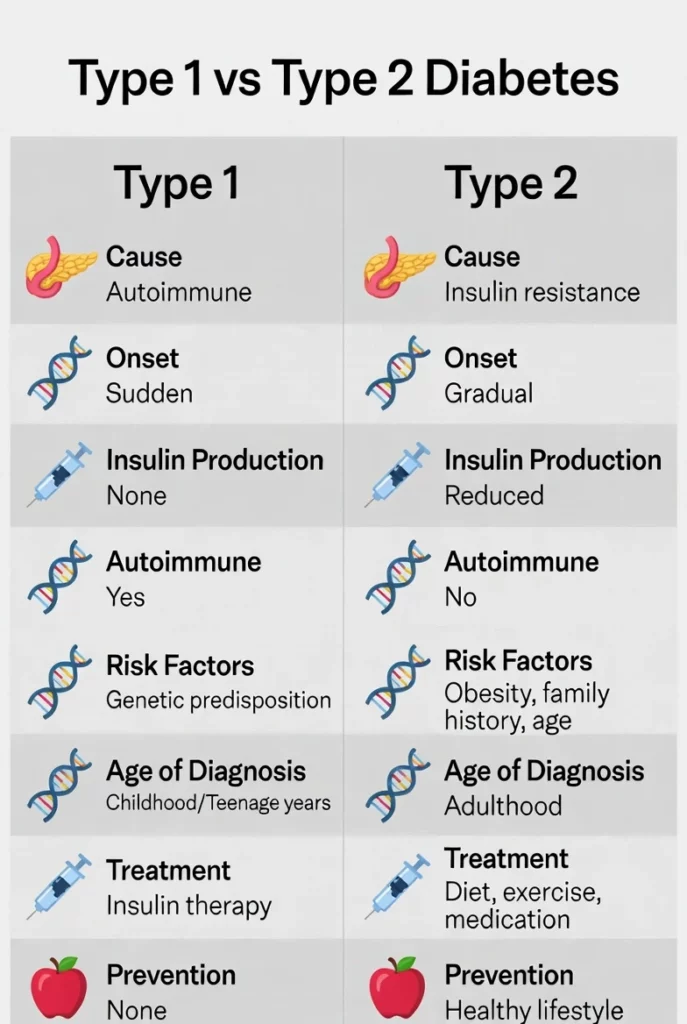
Understanding what is the difference between type 1 and type 2 diabetes is essential for proper care. While both result in high blood sugar, their “mechanisms of action” are polar opposites.
One involves an “insulin shortage,” while the other involves an “insulin blockage.” In my clinical experience, I have found that patients feel more empowered when they know exactly why their sugar is high. Let’s compare them directly.
| Feature | Type 1 Diabetes | Type 2 Diabetes |
| Primary Cause | Autoimmune (Immune system attack) | Insulin Resistance & Genetics |
| Insulin Status | The body makes zero insulin | The body makes insulin, but can’t use it |
| Age of Onset | Usually children or young adults | Usually adults, though rising in teens |
| Prevention | Currently no known way to prevent | Often preventable with lifestyle habits |
| Treatment | Required insulin injections/pumps | Diet, exercise, oral meds, or insulin |
What Causes Diabetes?
So, what causes diabetes exactly? The answer depends on your specific type. For Type 1, the trigger is likely a combination of genetics and environmental factors, like a virus.
In contrast, what is the cause of diabetes for Type 2 involves many factors. These include family history, physical inactivity, and carrying excess weight around the midsection. Furthermore, some ethnicities are at a higher genetic risk.
I once worked with a patient who felt immense guilt about his diagnosis. However, after reviewing his family tree, we saw a clear pattern. Causes of diabetes are rarely the fault of the patient alone. Biology plays a massive role in how your body handles carbohydrates.
What Is Insulin Resistance?
To truly grasp Type 2, you must know what is insulin resistance. Imagine you are trying to enter a room, but the door is swollen shut. You push and push, but you cannot get in.
In your body, the “door” is your cell membrane. Insulin is trying to push sugar into that door. When you have resistance, the cell ignores the signal. Consequently, the pancreas pumps out even more insulin to force the door open. Eventually, the pancreas gets “burned out,” and blood sugar levels rise.
What Are the Symptoms and Warning Signs of Diabetes?
Recognizing what is diabetes symptoms early can literally save your life. Because high blood sugar often builds up slowly, many people “get used” to feeling unwell. They might blame their fatigue on a busy work week.
However, your body is usually sending out distress signals. When glucose builds up in the blood, it spills into the urine. This process drags water out of your tissues.
Consequently, you feel dehydrated no matter how much you drink. In my clinical practice, I often hear patients describe a “foggy” feeling. This happens because the brain is not receiving the glucose it needs for energy. Furthermore, the high sugar levels can actually change the shape of the lens in your eye. This leads to the blurred vision that many people mistake for a need for new glasses.
5 Common Symptoms of Diabetes
If you are looking for what are 5 symptoms of diabetes, these are the most frequently reported:
- Extreme Thirst: Feeling like you can’t get enough water (Polydipsia).
- Frequent Urination: Needing to go multiple times during the night (Polyuria).
- Unexplained Weight Loss: Your body starts burning fat for energy because it can’t use sugar.
- Constant Hunger: Even after eating, your cells feel “starved” (Polyphagia).
- Fatigue: A deep, persistent exhaustion that sleep doesn’t fix.
10 Warning Signs of Diabetes
Beyond the basics, there are 10 warning signs of diabetes that deserve your attention. If you notice these, schedule a check-up immediately:
- Slow-healing sores or frequent infections.
- Tingling or numbness in the hands and feet (Neuropathy).
- Patches of darkened skin, especially around the neck or armpits.
- Irritability or sudden mood changes.
- Blurred vision that comes and goes.
- Dry, itchy skin.
- Gums that are red, swollen, or receding.
- Fruity-smelling breath (a sign of high ketones).
- Recurring yeast infections in women.
- Sudden erectile dysfunction in men.
How Is Diabetes Diagnosed?
If you have symptoms, your doctor will order a what is diabetes blood test called—usually several different ones. These tests measure how much sugar is sticking to your red blood cells or floating in your plasma. The most common test is the A1C.
People often ask, what alc is diabetes, referring to this specific metric. The A1C gives a three-month average of your blood sugar. It is the “gold standard” because it doesn’t just show a single moment in time. Additionally, you might hear about what is gmi in diabetes.
GMI stands for Glucose Management Indicator. If you wear a Continuous Glucose Monitor (CGM), the GMI estimates what your A1C would be based on your recent sensor data. This is a helpful tool for adjusting your daily habits in real-time.
Diabetes Diagnostic Ranges
| Test | Normal | Prediabetes | Diabetes |
| A1C (HbA1c) | Below 5.7% | 5.7% to 6.4% | 6.5% or higher |
| Fasting Glucose | 70–99 mg/dL | 100–125 mg/dL | 126 mg/dL + |
| OGTT (2-hour) | Below 140 mg/dL | 140–199 mg/dL | 200 mg/dL + |
What Blood Sugar Levels Are Dangerous in Type 2 Diabetes?
Understanding what level of blood sugar is dangerous for type 2 diabetes is vital for safety. Generally, a reading above 240 mg/dL (13.3 mmol/L) is considered quite high. At this level, you should check for ketones if you have Type 1.
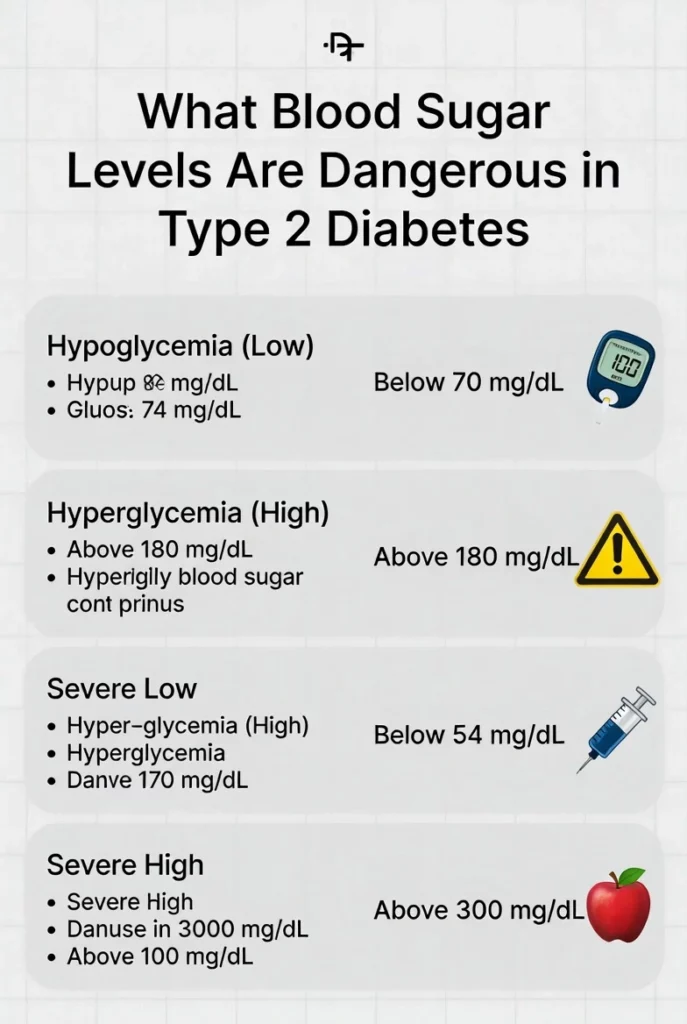
For Type 2, consistently staying above 300 mg/dL can lead to severe dehydration or a “Hyperosmolar State.” If your blood sugar hits 600 mg/dL or higher, it is a medical emergency. You may experience confusion, seizures, or loss of consciousness. Therefore, monitoring your levels daily is the best way to prevent these “danger zones.”
What Is Diabetic Ketoacidosis (DKA)?
What is ketoacidosis? This is a life-threatening complication where the blood becomes too acidic. It happens when your body has no insulin. Because the cells can’t get sugar, they burn fat at a dangerously fast rate.
This fat-burning produces “ketones.” Too many ketones turn the blood into an acidic environment that damages the brain and heart. While more common in Type 1, people with Type 2 can also experience DKA during severe illness. Symptoms include vomiting, stomach pain, and rapid breathing. If you suspect DKA, go to the Emergency Room immediately.
How Does Diabetes Affect Your Life?
When you receive a diagnosis, you might wonder, how does diabetes affect your life? Honestly, it changes your daily rhythm. You become much more aware of what you eat and how you move.
During a conversation with Dr. Lloyd, she mentioned a patient who felt “trapped” by his glucose monitor. We worked together to show him that the monitor actually provided freedom. It allowed him to see which foods worked for his body.
Furthermore, diabetes impacts your mental health. “Diabetes distress” is a real term used by psychologists. It describes the burden of 24/7 self-care. However, with the right support system, most people find a “new normal.” You can still travel, hike, and enjoy meals; you just do so with a bit more planning.
What Is Metformin Used for Other Than Diabetes?
Metformin is the most prescribed medication for Type 2. But you might have heard about what is metformin used for other than diabetes. In the medical world, we often use it “off-label” for several reasons. For example, it is a primary treatment for Polycystic Ovary Syndrome (PCOS). It helps lower insulin levels and can restore regular ovulation.
Additionally, some researchers are studying metformin for its potential “anti-aging” properties and heart protection. However, we must be clear: the FDA has not approved metformin as an anti-aging drug. It is a powerful tool for metabolic health, but it should only be used under strict medical supervision. Always talk to your doctor about the risks and benefits before starting any new medication.
Diabetes Explained by the NHS (UK Perspective)
If you are in the UK, you will likely look for what is diabetes nhs guidance. The National Health Service provides excellent structured care through your GP. In the UK, blood sugar is measured in millimoles per litre (mmol/L) rather than mg/dL.
A “normal” fasting reading in the UK is typically between 4.0 and 5.9 mmol/L. Furthermore, the NHS focuses heavily on the “Healthier You” Diabetes Prevention Programme. This is a evidence-based initiative designed to help people with prediabetes return to normal levels through coached lifestyle changes.
When to See a Doctor
If you have read this far and recognize the symptoms, it is time to act. Do not wait for a “better time” to get tested. Early intervention is the key to avoiding complications like kidney disease or vision loss.
See a healthcare professional if:
- You have an unquenchable thirst that lasts for days.
- You have a family history of Type 1 or Type 2 and feel “off.”
- Your home glucose monitor (if you have one) shows a fasting level over 126 mg/dL.
- You have a wound on your foot that is not healing.
Frequently Asked Questions
Can you cure diabetes?
Currently, there is no “cure” for Type 1 or Type 2. However, Type 2 can often be put into “remission.” This means your blood sugar returns to normal levels without the need for medication, usually through significant weight loss and diet changes.
Is diabetes caused by eating too much sugar?
Not exactly. Type 1 is autoimmune and unrelated to diet. Type 2 involves a complex mix of genetics and lifestyle. While a high-sugar diet contributes to weight gain and insulin resistance, it is rarely the only cause.
Does everyone with diabetes need insulin?
No. Everyone with Type 1 needs insulin. However, many people with Type 2 manage their condition with oral medications like metformin, diet, and exercise.
Can stress cause diabetes?
Stress does not directly “cause” diabetes. However, chronic stress raises cortisol levels. Cortisol makes your body more resistant to insulin. Therefore, high stress can make prediabetes progress faster or make existing diabetes harder to control.
What is the most dangerous type of diabetes?
All types are serious if they are not managed. However, Type 1 and DKA represent more immediate medical emergencies. Type 2 is dangerous because its “silent” nature can damage your heart and kidneys over many years without you noticing.
Conclusion: Knowledge is Your Best Tool
In conclusion, what is diabetes? It is a complex, life-altering condition, but it is not one that has to define you. By understanding your specific type and the underlying mechanisms like insulin resistance, you can make informed choices.
Whether you are adjusting your diet or starting new medications, every small step counts toward a healthier future. Remember, your healthcare team is there to support you. Are you ready to take the first step and schedule your screening?